
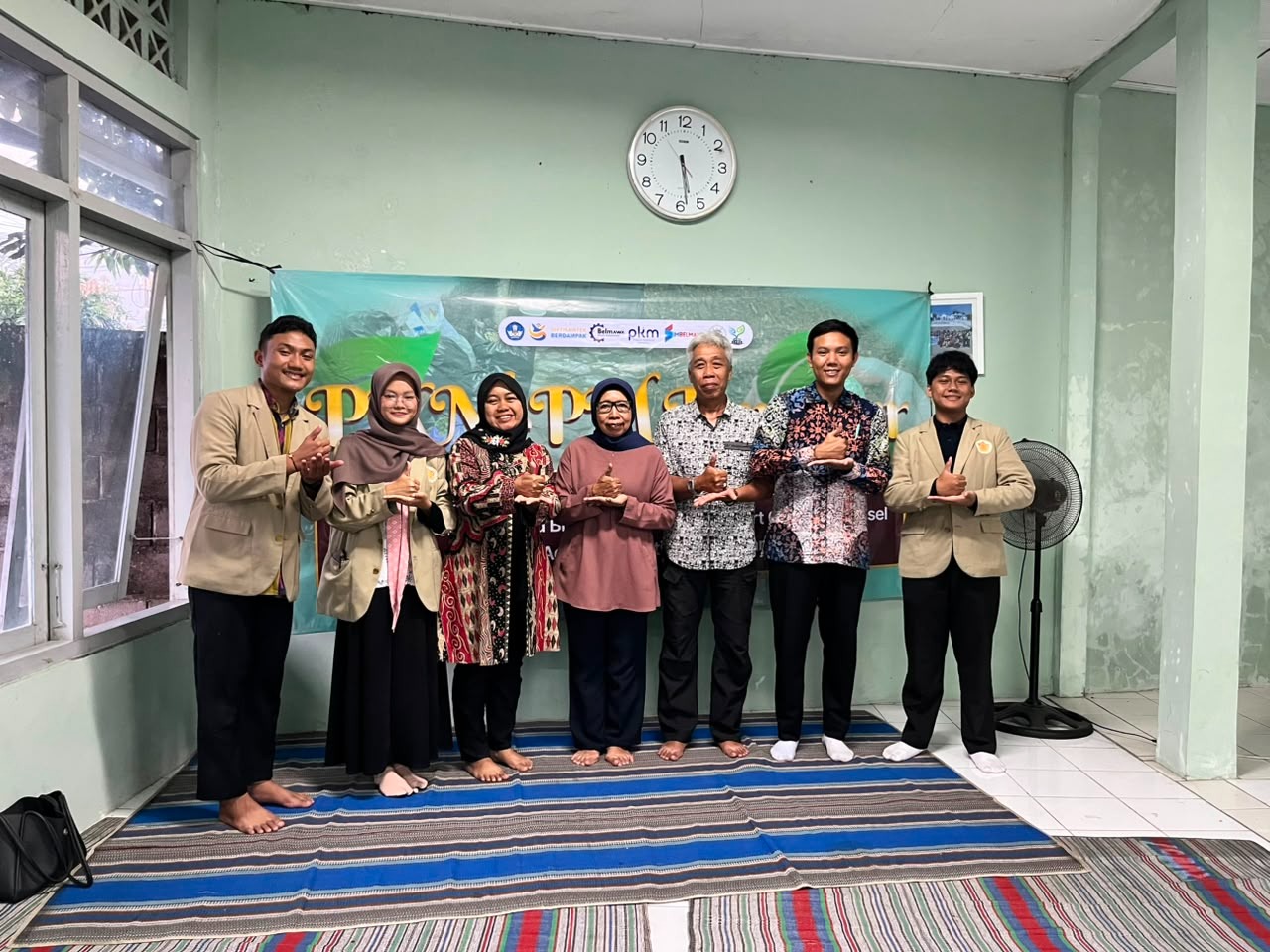
The Student Creativity Program Team for Community Service (PKM-PM) of Gadjah Mada University (UGM) Tumandur carried out a socialization activity entitled “Empowering the PKK Women of Jurugsari Village through the Transformation of Organic Waste into Smart Compost Vessel-Based Liquid Biofertilizer towards an Agroregenerative Family Farm”. This activity took place on Monday, June 22, 2026 in Kampung Jurugsari RW 57, Joho, Condongcatur, Depok, Sleman, Special Region of Yogyakarta.
This program demonstrates UGM students’ concrete contribution to addressing environmental challenges, particularly the high volume of household waste, which is predominantly organic. Unmanaged waste accumulation has the potential to cause environmental pollution, degrade public health, and reduce the comfort of life.

Through the innovative Smart Compost Vessel, The Tumandur PKM-PM Team introduced the technology of processing household organic waste into liquid organic fertilizer (liquid biofertilizer). This product not only helps communities manage waste independently, but also provides added value by supporting home gardening as part of family food security.
The socialization activity was attended by 16 participants from the PKK Women of Jurugsari Village, and was attended by Mr. Purwoko as the Head of RW 57, Mrs. Rini as the Head of PKK of Jurugsari Village, Ms. Retnaningsih as the Head of Joho Hamlet, Apri Nugroho as the representative of Condongcatur Village, and the UGM PKM-PM Team.
The Tumandur PKM-PM team consists of Siti Nur Khasanah (Soil Science 2024), Rayhan Arva Pradipa (Tourism 2024), Nafi’atush Sholikhah (Animal Science and Industry 2023), Vina Ayu Lestari (Electronics and Instrumentation 2023), and Naafianda Ra’uuf Prastya (English 2024), with the guidance of Dr. Ir. Miftahush Shirothul Haq, S.Pt., IPP. from the Faculty of Animal Husbandry, UGM.
Team leader Siti Nur Khasanah emphasized that the program was designed as a collaborative learning platform for the community. “We hope this program can become a learning platform for managing organic waste to better benefit the environment and home gardens,” she said.
Ms. Rini expressed her appreciation for the thorough preparation carried out by the UGM PKM-PM Team and expressed her hope that the program would continue. Similar support came from Mr. Purwoko, Ms. Retnaningsih, and Apri Nugroho, who emphasized the importance of good cooperation and communication between the community and the local government to ensure the program runs smoothly and provides tangible benefits.
The enthusiasm of the participants was seen through interactive discussions regarding the mechanisms for processing organic waste, the use of Smart Compost Vessel, and the use of liquid fertilizer for cultivating food crops in home gardens.
The Tumandur Program supports the achievement of several Sustainable Development Goals (SDGs), including SDG 2: Zero Hunger by strengthening family food security through home gardening and the use of liquid organic biofertilizer, SDG 3: Good Health and Well-Being by promoting healthier environmental management, SDG 4: Quality Education through community education and capacity building on organic waste management, SDG 5: Gender Equality by empowering PKK women as key agents of change within families and communities, SDG 11: Sustainable Cities and Communities through reducing household organic waste, SDG 12: Responsible Consumption and Production by transforming organic waste into value-added products, and SDG 15: Life on Land by promoting the use of organic biofertilizers to support healthy soils and sustainable agricultural practices. Thus, this activity not only strengthens the synergy between academia and the community but also creates tangible impacts on environmental sustainability, family food security, and social well-being in Jurugsari Village.
Author: Nafi’atush Sholikhah, Beny Nabila Happy Fauziah
Editor: Tantriani
Documentation: Rayhan Arva Pradipa