
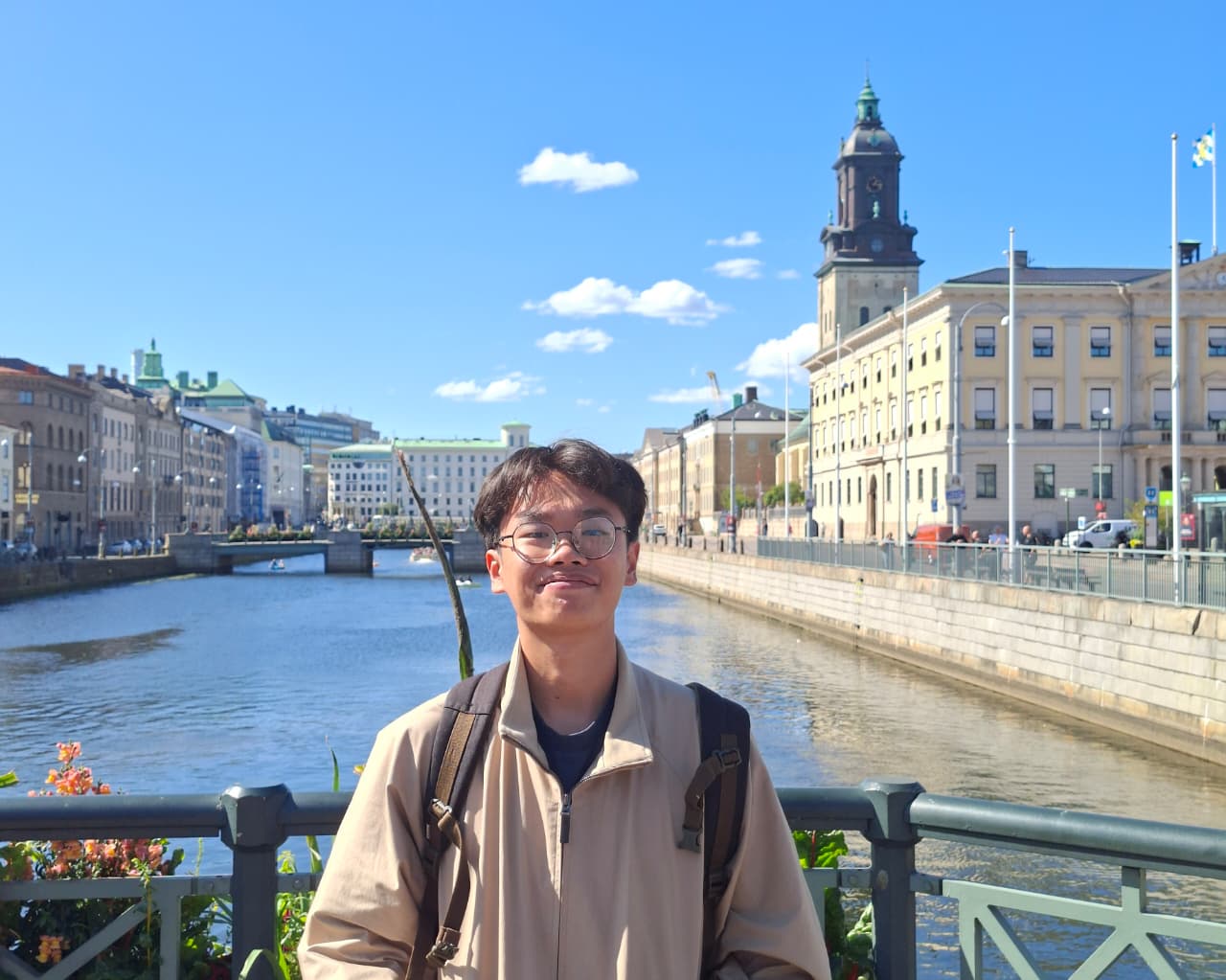
Thousands of kilometers away from the aquaculture ponds and lecture halls of the Faculty of Agriculture, Universitas Gadjah Mada (UGM), Gerson Lewis, a 2023 cohort student of the Aquaculture Study Program, is currently undertaking a one-semester exchange program at Lund University, Sweden. This program is part of the Erasmus+ International Credit Mobility Programme (KA131/171), running from August 18, 2026, to January 17, 2027.
Lewis’s interest in the program stemmed from his observations of Indonesia’s fisheries and aquaculture sector. He noted that innovations born from research and field practice often struggle to develop into economically sustainable enterprises. For him, the exchange at Lund University is an opportunity to explore this issue from a different perspective, studying how policies, legal frameworks, and sustainability approaches are implemented in Sweden, a country recognized for its strong environmental governance and ranked as the top innovator in the European Union according to the European Innovation Scoreboard 2026, with a vibrant startup ecosystem.

During his semester in Lund, Lewis is enrolled in courses covering environmental and sustainability studies, international law, and nature-based solutions for urban planning. This academic combination provides him with a broader framework to view aquaculture not only from the technical side of production but also from the perspectives of regulation, environmental governance, and business development strategies. He also explored topics on the social dimensions of technology and artificial intelligence, perspectives that he believes are rarely addressed in applied science curricula.
The selection process for Lund, according to Lewis, was entirely document-based without an interview stage. Nevertheless, he emphasized that the preparation was far from simple. “A strong CV cannot be built overnight. It is the result of years of hard work,” he remarked. He added that the motivation letter was a crucial space to articulate his goals, his alignment with the program, and the impact he aspired to create, rather than merely fulfilling an administrative requirement.

Reflecting on his journey, Lewis shared his message with fellow students. At the beginning of his studies, he never imagined reaching this stage, yet he chose to continuously challenge himself to dream bigger. He quoted a phrase often attributed to Soekarno: “Dream as high as possible, so that when you fall, you will land among the stars.”
Lewis’s participation in the program also contributes to the achievement of the Sustainable Development Goals (SDGs) through education, innovation, sustainability, governance, and international collaboration. SDG 4: Quality Education is reflected in the international learning experience, which broadens students’ academic perspectives, intercultural competencies, and understanding of sustainability beyond national contexts. SDG 9: Industry, Innovation and Infrastructure is supported through exposure to applied research, emerging technologies, and innovation ecosystems that can strengthen the connection between scientific knowledge and practical solutions.
As an Aquaculture student, Lewis’s experience is particularly relevant to SDG 14: Life Below Water, by strengthening perspectives on sustainable fisheries and aquaculture and the relationship between production activities and the long-term health of aquatic ecosystems. His exploration of sustainability and nature-based solutions also contributes to SDG 13: Climate Action, particularly by introducing approaches that recognize the role of nature-based interventions in addressing environmental and climate-related challenges.
The program further relates to SDG 8: Decent Work and Economic Growth, particularly through Lewis’s interest in transforming research and field-based innovations into economically sustainable enterprises. Meanwhile, his exposure to international law, policy, and environmental governance contributes to SDG 16: Peace, Justice and Strong Institutions, highlighting the importance of effective policies, sound legal frameworks, and strong institutions in advancing sustainable development.
Finally, SDG 17: Partnerships for the Goals is reflected in the academic collaboration and international mobility facilitated through the partnership between UGM and Lund University. Together, these dimensions demonstrate that international student mobility can serve not only as an academic opportunity but also as a platform for developing young professionals capable of connecting knowledge, innovation, governance, economic development, and environmental sustainability.
With a spirit of cross-border learning, Gerson Lewis demonstrates that Indonesian agricultural students are capable of contributing to global dialogues on sustainability, innovation, and environmental governance. His experience in Lund represents more than an academic exchange—it is an opportunity to broaden perspectives, build international networks, and bring home new ideas for advancing sustainable aquaculture and agriculture in Indonesia.
Authors: Gerson Lewis, Beny Nabila Happy Fauziah
Editor: Tantriani
Documentation: Gerson Lewis