
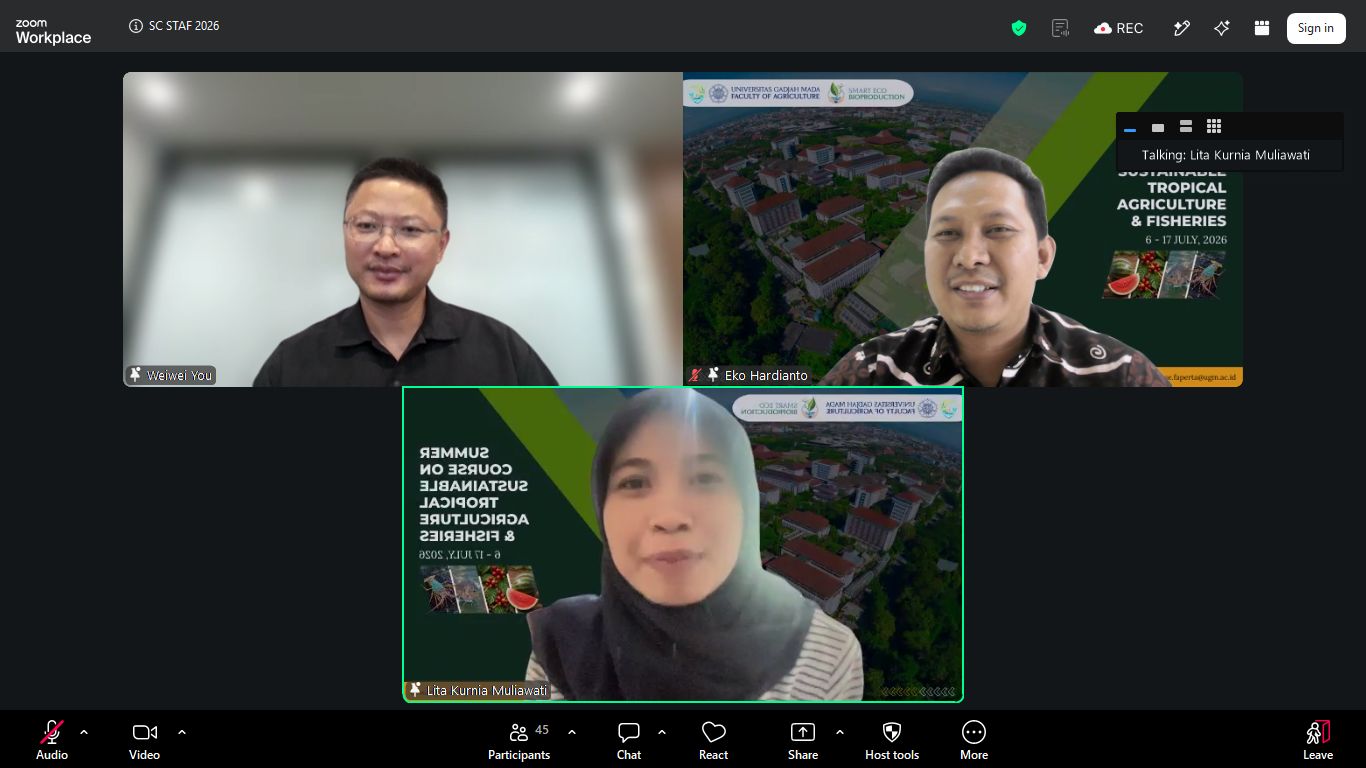
The fourth day of the Summer Course on Sustainable Tropical Agriculture and Fisheries (SC-STAF) 2026, organized by the Faculty of Agriculture, Universitas Gadjah Mada (Faperta UGM), on Thursday, July 9, 2026, proceeded with great enthusiasm. The parallel classroom transformed into a center for international interactive discussion as participants from 7 countries were invited to delve into modern aquaculture innovations based on marine ecosystems or blue food.
One of the speakers featured in this parallel session was Prof. Weiwei You, Ph.D. He is a mariculture scientist who currently serves as the Vice Dean of the College of Ocean and Earth Sciences at Xiamen University, China. In addition to actively leading more than 30 strategic national research projects, Prof. You also holds important positions as the Vice President of the International Abalone Society and a member of the Technical Advisory Board at the Aquaculture Stewardship Council (ASC).
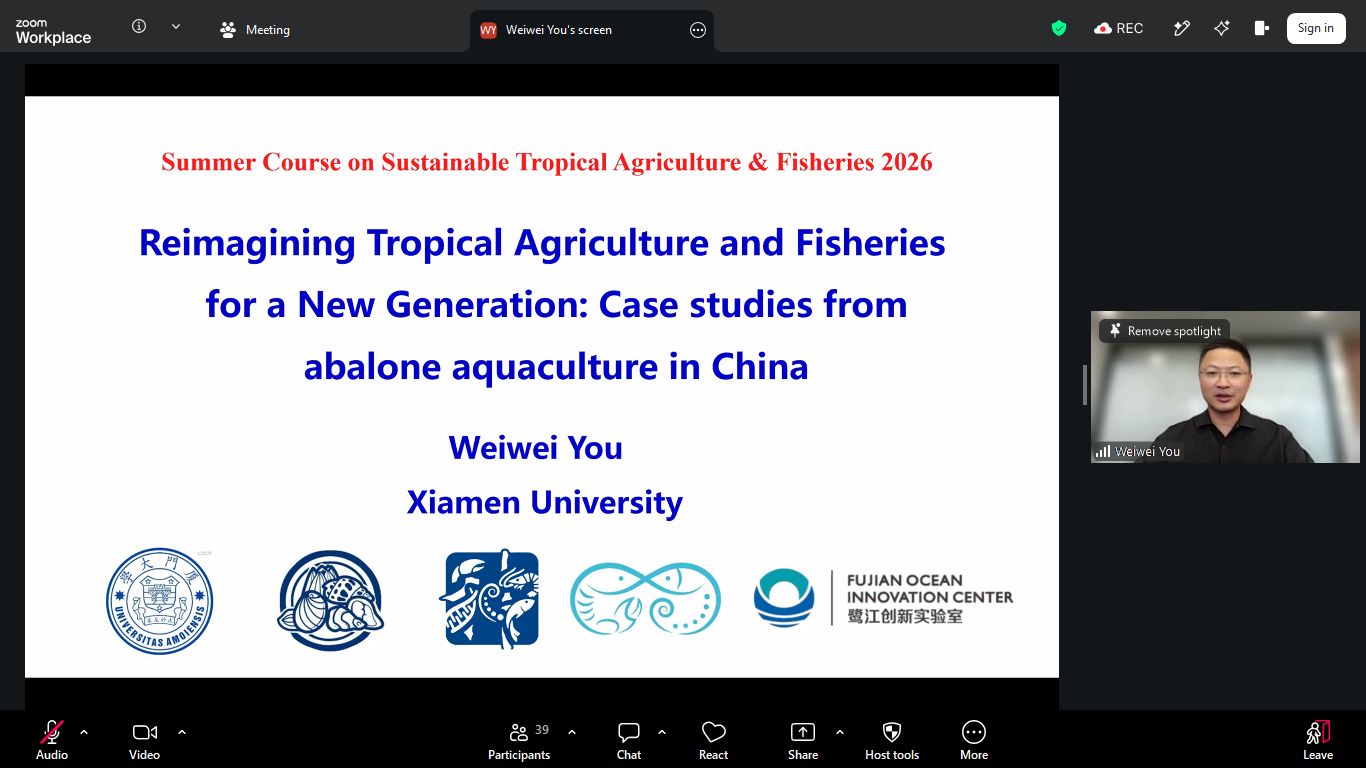
In his presentation, “Reimagining Tropical Agriculture and Fisheries for a New Generation: Case Studies from Abalone Aquaculture in China,” Prof. You discussed the rapid growth of the global blue economy, which is projected to expand from USD 1.3 trillion to USD 2.6 trillion. He highlighted abalone as one of China’s most valuable aquaculture commodities, noting that the country is currently the world’s largest producer and consumer of abalone. Today, farmed abalone accounts for approximately 95 percent of global production, largely due to the decline of wild populations.
In conclusion, Prof. You emphasized that the future direction of mariculture must rely on the One-Health aquaculture principle. This approach integrates health harmony among humans, farmed organisms, and the shared environment through Government-Scientist-Enterprise synergy. The implementation of Integrated Multi-trophic Aquaculture (IMTA), which combines kelp seaweed, abalone, and sea cucumbers within a single net cage area, serves as a concrete example of a balanced ecosystem.
The facilitation of this international class by Faperta UGM reinforces the institution’s tangible contribution to guiding the achievement of global Sustainable Development Goals (SDGs). The discussion regarding eco-friendly and nutrient-rich marine food production systems (blue food) aligns with the fulfillment of SDG 2: Zero Hunger and SDG 3: Good Health and Well-being. Furthermore, innovations in offshore mechanization platforms and abalone genomic research support the achievement of SDG 9: Industry, Innovation and Infrastructure, while the commitment to safeguarding coastal ecosystems and the ASC sustainability certification fully contribute to meeting the targets of SDG 14: Life Below Water for the preservation of future food. In addition, this international collaboration also supports the achievement of targets under SDG 17: Partnerships for the Goals.
Writer: Rani Nur Rochim
Editor: Tantriani
Documentation: SC-STAF 2026 Team