
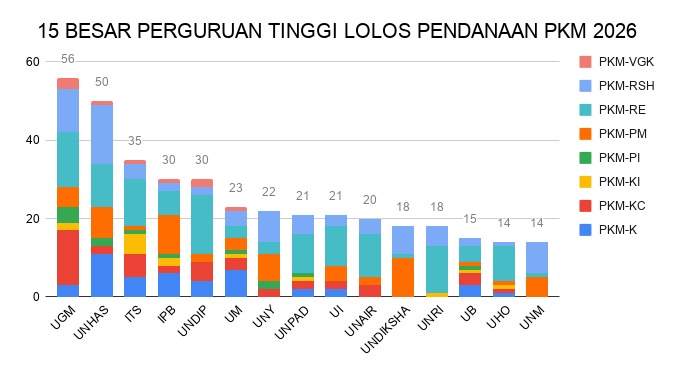
Universitas Gadjah Mada (UGM) secured the national first rank among higher education institutions with the highest number of funded Program Kreativitas Mahasiswa (Student Creativity Program, PKM) project titles in 2026. The official announcement was released by the Director of Learning and Student Affairs, Directorate General of Higher Education, Ministry of Higher Education, Science, and Technology, on May 22, 2026. This achievement stands as strong evidence that UGM’s academic ecosystem continues to foster creative, solution‑oriented, and impactful ideas for society.
Within this accomplishment, the Faculty of Agriculture, UGM (Faperta UGM), contributed significantly through student projects in the PKM‑PM (PKM Community Service) scheme. One of the funded titles that helped UGM reach this top position is “Tumandur: Empowering the PKK of Jurugsari Hamlet through the Transformation of Organic Waste into Liquid Biofertilizer Based on a Smart Compost Vessel, toward an Agro‑regenerative Family Farm.” The project is led by Siti Nur Khasanah and supervised by Dr. Ady Bayu Prakoso, S.P., reflecting Faperta UGM’s active role in generating applicable agricultural innovations oriented toward community empowerment.
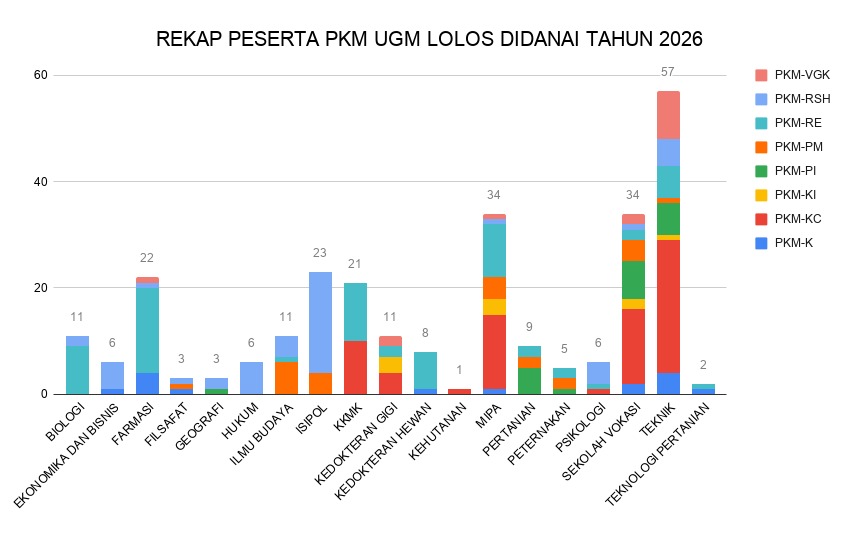
Faperta UGM’s participation in PKM 2026 highlights the faculty’s consistency in encouraging students not only to excel academically but also to translate their knowledge into real‑world solutions in the field. Through the PKM‑PM project “Tumandur,” Faperta UGM students addressed the problem of organic‑waste management while offering a simple, low‑cost, and sustainable technological approach.
The project focuses on transforming organic waste into liquid biofertilizer using a Smart Compost Vessel, an idea that combines technology, family empowerment, and regenerative agriculture. This approach demonstrates how Faperta UGM drives agricultural innovation beyond theory and directly into practical community‑empowerment activities.
Faperta UGM’s contribution through PKM‑PM “Tumandur” is highly relevant to the Sustainable Development Goals (SDGs), especially SDG 2: Zero Hunger, through strengthening sustainable agricultural productivity; SDG 12: Responsible Consumption and Production, by managing organic waste into usable products; SDG 13: Climate Action, through a regenerative‑agriculture approach that is more environmentally friendly. In addition, the project aligns with SDG 17: Partnerships for the Goals, by fostering collaboration among students, lecturers, and the community within a single empowerment movement. Through such contributions, Faperta UGM reaffirms its role as a faculty that not only produces excellent graduates but also generates innovations that support sustainable and inclusive agricultural development.
Writer: Rani Nur Rochim
Editor: Tantriani