
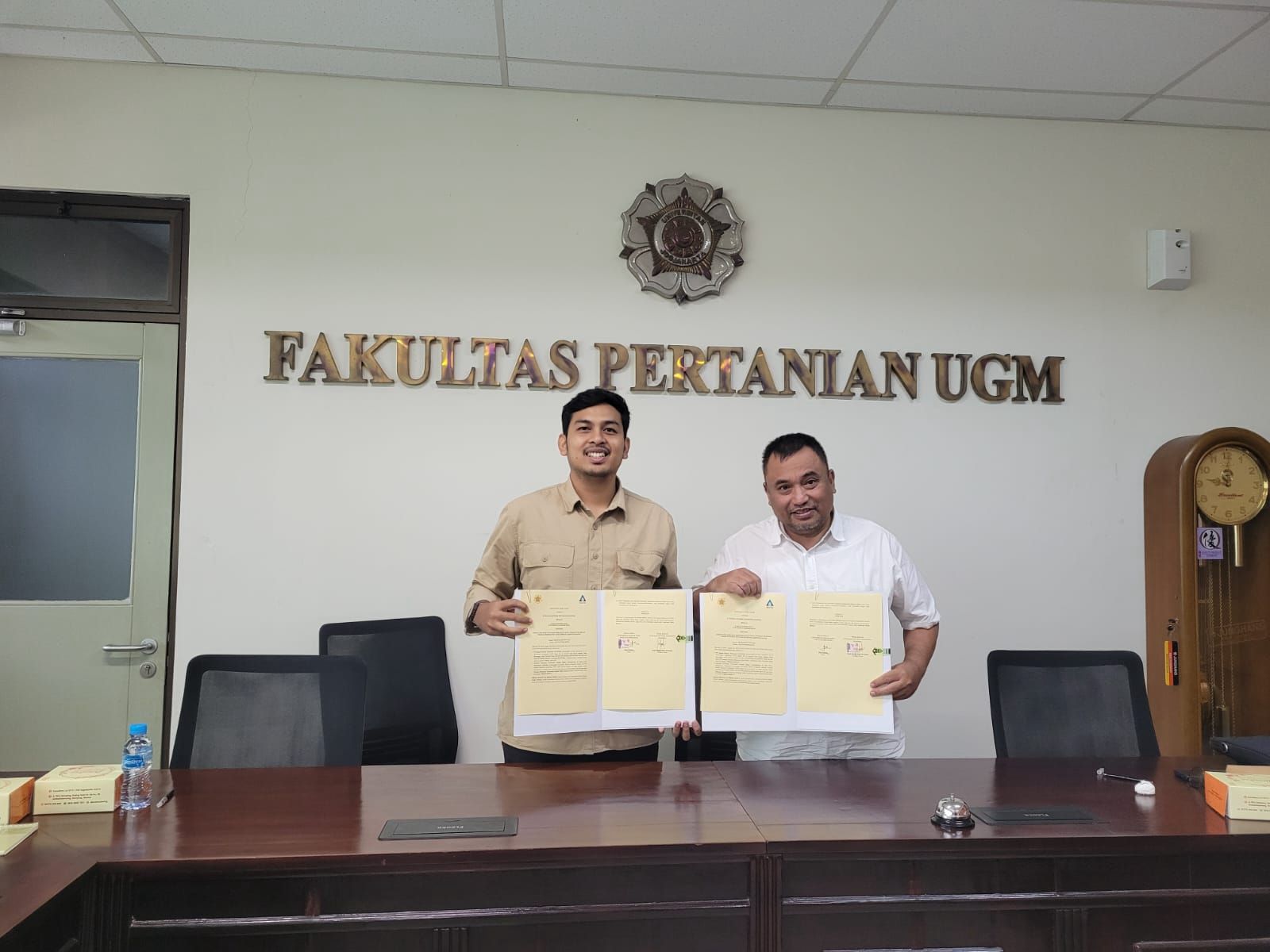
The Faculty of Agriculture, Universitas Gadjah Mada (Faperta UGM), and PT Inamas Sintesis Teknologi (INASTEK) officially signed a Cooperation Agreement (PKS) regarding research, development, and promotion of downstreaming innovative products in the field of agrotechnology on Monday, February 2, 2026, in Yogyakarta. In the agreement, Faperta UGM was represented by the Dean of the Faculty of Agriculture UGM, Prof. Ir. Jaka Widada, M.P., Ph.D., while PT INASTEK was represented by the President Director, Yosef Adhitya Duta Dewangga. This collaboration focuses on two main scopes: research and development in the field of agrotechnology and the promotion of downstreaming innovative products generated through the parties’ collaboration.

As a form of concrete support, PT INASTEK will provide human resources consisting of practitioners and skilled workers, as well as utilize its industry network to strengthen the implementation of research and promotion of agrotechnology innovation downstreaming. The involvement of practitioners is expected to provide market perspectives, understanding of industry standards, and information regarding current technological needs, ensuring that research directions are more targeted and oriented toward end-user needs. Furthermore, PT INASTEK’s industry network can be utilized as a channel for market testing, mapping distribution partners, and strengthening the business ecosystem for the innovative products generated. This support is a crucial factor in bridging the gap between laboratory research results and the needs of the agricultural and agro-industry sectors in the field.
With this collaboration, Faperta UGM is expected to further strengthen its position as an excellent faculty in agricultural research and innovation downstreaming, while simultaneously accelerating the application of research results to society and the business world to support sustainable agricultural development in Indonesia. Faperta UGM’s role as a leading institution in agricultural research and innovation, particularly in ensuring that scientific outputs are translated into applicable technologies, products, and models that benefit farmers, micro, small and medium enterprises (MSMEs), and industry.
This cooperation scheme also demonstrates Faperta UGM’s contribution to achieving the Sustainable Development Goals (SDGs), including SDG 2: Zero hunger, SDG 9: Industry, innovation and infrastructure, SDG 12: Responsible consumption and production, and SDG 17: Partnerships for the goals.
Writer: Rani Nur Rochim
Editor: Tantriani