
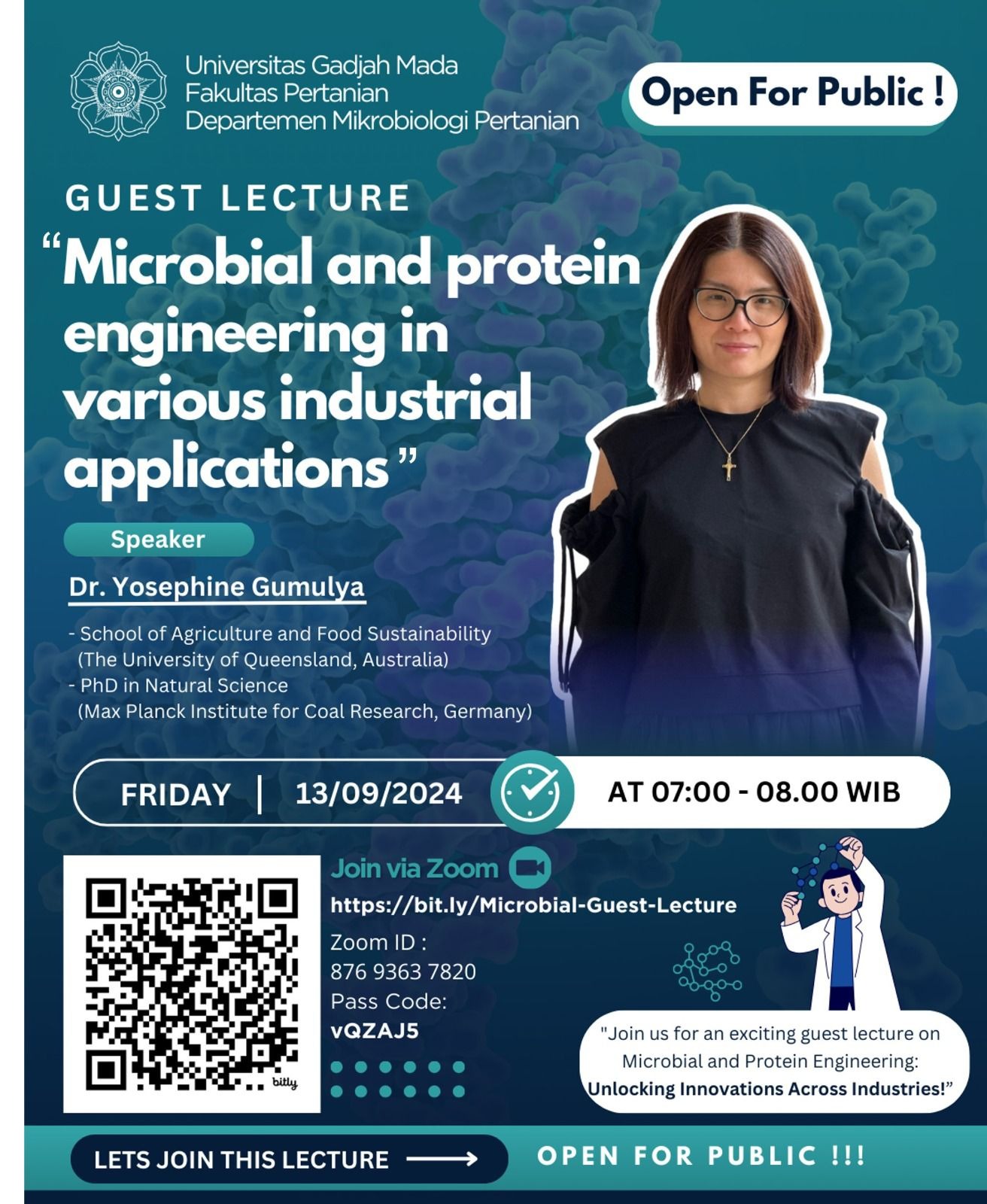
On Friday, 13 September 2024, the Department of Agricultural Microbiology at Gadjah Mada University (Faperta UGM) held a guest lecture titled “Microbial and Protein Engineering in Various Industrial Applications.” The event, conducted virtually via Zoom, featured Dr. Yosephine Gumulya from the School of Agriculture and Food Sustainability, The University of Queensland, Australia, as the speaker.
The event opened with a speech from Prof. Ir. Irfan Dwidya Prijambada, M.Eng., Ph.D., who highlighted the importance of the topic in the industrial world.
“Microbial and Protein Engineering has numerous applications, especially in various industrial activities. I hope this lecture will provide new insights to students regarding microbial activities and protein engineering in the industry. I also hope this will be beneficial for the students,” said Prof. Irfan.

In her presentation, Dr. Yosephine Gumulya explained that enzyme and microbial engineering are powerful approaches to modifying proteins and microbes to meet specific needs in various industrial applications. She emphasized that this technology can be utilized in various sectors such as white biotechnology for chemical production, red biotechnology for drug production, and green biotechnology for environmental recovery and bioremediation.
Dr. Yosephine also discussed protein engineering for pharmaceutical applications, particularly in developing innovative Cytochrome P450 enzymes for drug metabolite synthesis. Additionally, she elaborated on the CLADE (Combinatorial Libraries of Ancestors for Directed Evolution) method and the development of a new ketol acid reductoisomerase enzyme.
Furthermore, Dr. Yosephine explained the potential of microbial engineering in resource recovery, such as biomining for low-grade ores, enhancing microbial resistance to environmental stress, and advanced applications in space exploration. She also discussed engineered microbes for food applications, including plant-based milk alternatives, plant-based yogurt, and plant fermentation.
The guest lecture was interactive and lively, as many students and faculty members actively participated in the Q&A session. Dr. Yosephine concluded her presentation with a message for the participants.
“Enzyme and microbial engineering is a powerful approach to harnessing proteins and microbes to meet specific needs in various industrial applications,” Dr. Yosephine emphasized.
This guest lecture provided students with new and in-depth insights into the applications of microbial and protein engineering across various industrial sectors, including pharmaceuticals, biotechnology, and food processing. The event also supports the achievement of several SDGs, namely SDG 4: Quality Education, SDG 9: Industry, Innovation, and Infrastructure, SDG 15: Life on Land, and SDG 17: Partnerships for the Goals.
Author: Agrit Kirana Bunda
Editor: Desi Utami
Documentation: Department of Agricultural Microbiology