
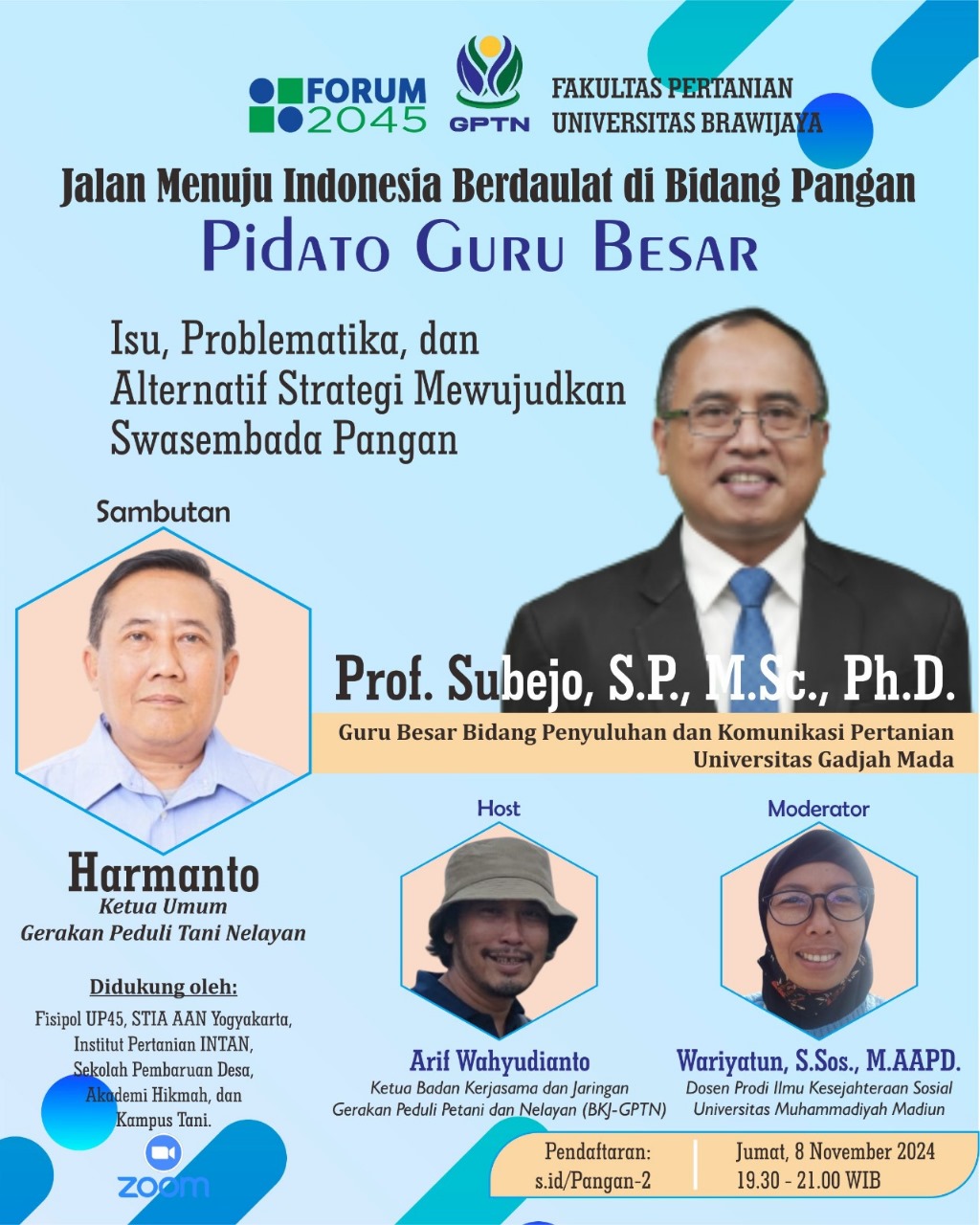
Prof. Subejo, S.P., M.Sc., Ph.D., a Professor at the Faculty of Agriculture, Universitas Gadjah Mada (Faperta UGM) in the field of Extension and Communication, addressed key issues and strategies to achieve national food self-sufficiency amidst global challenges. This was conveyed by Prof. Subejo during a national discussion held by the Gerakan Peduli Tani Nelayan (GPTN) with the theme “The Road to Indonesia’s Food Sovereignty” on Friday, 8 November 2024 via Zoom Meeting.
According to Prof. Subejo, the increasing demand for food driven by population growth is a major challenge that must be addressed seriously. Additionally, the phenomena of land grabbing and green capitalism are exacerbating the situation, as they often contradict the principles of food sovereignty, which prioritize the welfare of local farmers and equitable food access.
“In 2021, Indonesia ranked 69th in the Global Food Security Index (GFSI). This position was influenced by population growth, climate change, land conflicts, and inadequate infrastructure,” said Prof. Subejo.
During the discussion, the professor highlighted several solutions for achieving national food self-sufficiency, including the intensification of agriculture through modern technology, food diversification to reduce reliance on a single commodity, and the utilization of marginal lands to boost productivity. He also emphasized the importance of strengthening institutions and agricultural extension services to enhance farmers’ capacity to adopt innovations and support sustainable food security.
Prof. Subejo also drew attention to the issue of farmer regeneration, which is becoming increasingly concerning due to the lack of youth participation in the agricultural sector. In this regard, digital technology plays a vital role—one example being the DESA Apps developed by Faperta UGM, which provides farmers with access to information, innovation, and broader marketing opportunities.
The discussion underscored the importance of synergy among the government, academics, the private sector, and farming communities in tackling food-related challenges. Such cross-sector collaboration is expected to realize independent and sustainable food sovereignty.
The involvement of the Faculty of Agriculture UGM in these food issues serves as concrete evidence of its commitment to achieving several Sustainable Development Goals (SDGs), including SDG 1: No Poverty, SDG 2: Zero Hunger, SDG 4: Quality Education, SDG 8: Decent Work and Economic Growth, and SDG 17: Partnerships for the Goals.
Author: Agrit Kirana Bunda
Editor: Desi Utami