
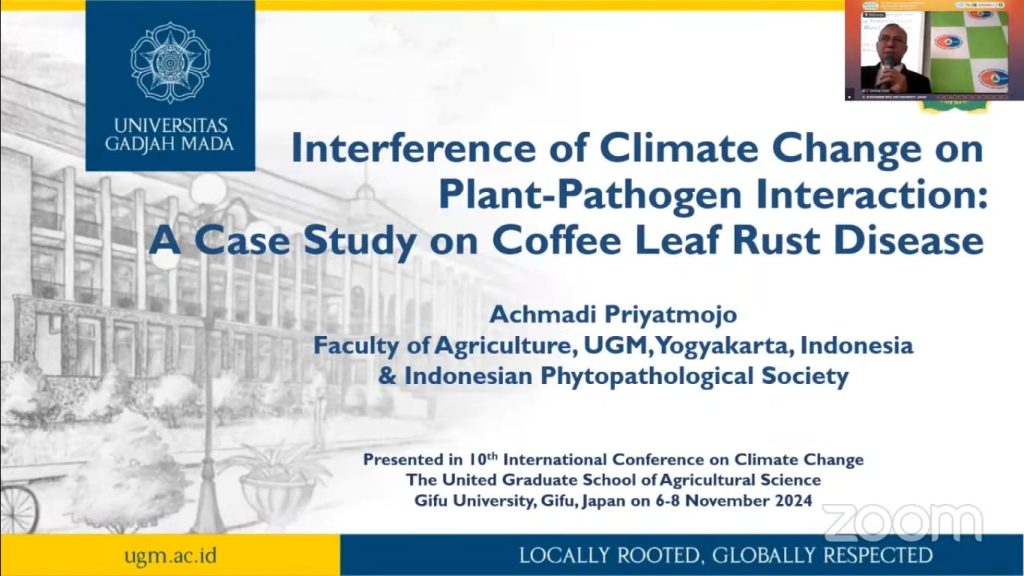
Prof. Ir. Achmadi Priyatmojo, M.Sc., Ph.D., also known as Prof. Ipik, a Professor in the Field of Plant Pests and Diseases at the Faculty of Agriculture, Gadjah Mada University (UGM), and the General Secretary of the Indonesian Phytopathology Society, made a significant contribution at The 10th International Conference on Climate Change (ICCC 2024). In his presentation titled “Interference of Climate Change on Plant-Pathogen Interaction: A Case Study on Coffee Leaf Rust Disease,” he highlighted the impact of climate change on coffee leaf rust disease.
ICCC 2024, held on 6-7 November, centered on the theme “Climate Change, Health, and Plant,” and was organized by Universitas Sebelas Maret in collaboration with the United Graduate School of Agricultural Science, Gifu University. This hybrid conference attracted over 150 participants, both in person and online, and served as a key platform for global researchers, scientists, and academics to discuss the major challenges presented by climate change.
Prof. Ipik discussed the impact of climate change on the interaction between coffee plants and pathogens, with a focus on Coffee Leaf Rust Disease (Hemileia vastatrix). He emphasized the crucial role of coffee in Indonesia, where it is one of the top commodities, ranking as the 5th largest coffee producer in the world. With over 10,000 coffee shops across the country, coffee has become an essential part of the livelihoods of many farmers and communities. Additionally, coffee plants play an ecological role in providing oxygen and preventing soil erosion, making them not only economically valuable but also ecologically significant.
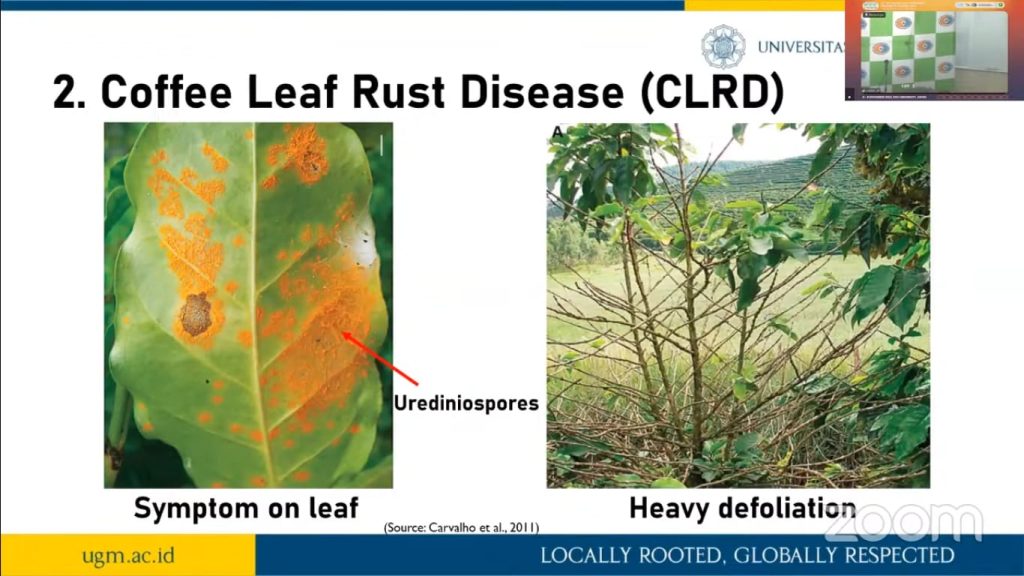
However, this commodity is facing a serious threat from Coffee Leaf Rust Disease, caused by the pathogen Hemileia vastatrix. This disease can lead to severe defoliation, disrupt photosynthesis, and reduce coffee yields. First discovered in Central Africa, the disease began spreading to Indonesia in 1876. Climate change has had a significant impact on the spread of this disease, as weather and environmental factors create conditions that favor the growth of the pathogen.
“There are several stages in the life cycle of Coffee Leaf Rust Disease, starting from leaf colonization, leaf penetration, spore germination, spore attachment, spore dispersal, to the development of new spores. These stages are generally influenced by weather and environmental factors such as wind, rain, temperature, light, soil moisture, as well as radiation and leaf humidity,” explained Prof. Ipik.
Research conducted by Prof. Ipik in several coffee-producing regions has shown that the pathogen Hemileia vastatrix grows optimally at temperatures around 25°C, compared to other temperatures like 10°C or 35°C. Climate change can affect the life cycle of the pathogen and the condition of the coffee plants, ultimately impacting the severity of the disease in various regions.
“It can be concluded that climate change affects the coffee plant, the fungal pathogen Hemileia vastatrix, and the interaction between them. Further research is needed to understand the growth of mycoparasites and their interactions with Hemileia vastatrix due to climate change in the field,” concluded Prof. Ipik in his presentation.
Prof. Ipik’s contribution to the international conference aligns with the Faculty of Agriculture UGM’s commitment to achieving the SDGs, including SDG 1: No Poverty, SDG 2: Zero Hunger, SDG 4: Quality Education, SDG 13: Climate Action, and SDG 17: Partnerships for the Goals.
Author: Agrit Kirana Bunda
Editor: Desi Utami
Documentation: YouTube Committee ICCC