
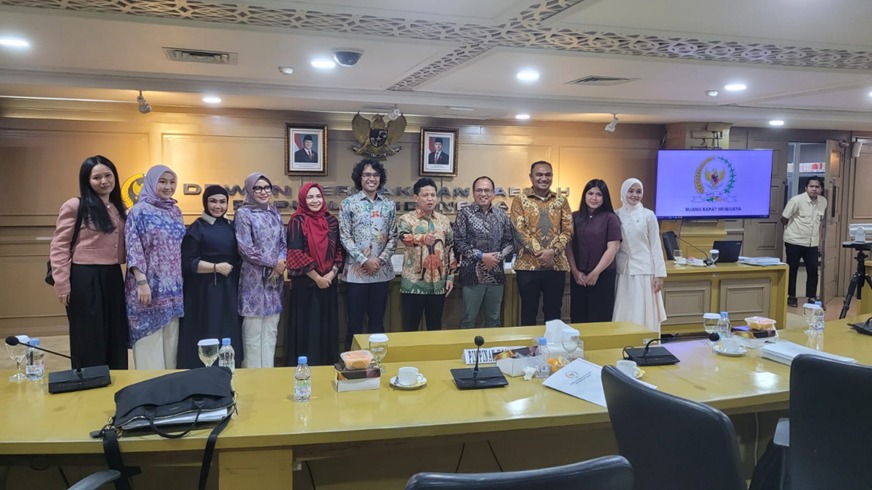
The commitment to strengthening the protection and empowerment of Indonesian farmers has entered a strategic phase through the Harmonization of the Third Amendment Bill to Law Number 19 of 2013. The event, held at the DPD RI Building, featured Prof. Subejo, S.P., M.Sc., Ph.D., Professor of the Faculty of Agriculture, Gadjah Mada University, as Coordinator of the Expert Team for Drafting the Bill. His presence emphasized the role of universities in overseeing public policies based on research and empirical experience.
As coordinator, Prof. Subejo led the drafting of the academic text, the formulation of the substance of the article changes, and the synchronization of input from academics, farmer organizations, local governments, ministries, and other stakeholders. A multidisciplinary approach involving experts in law, agricultural economics, institutions, and regional development demonstrated that this revision is not only normative but also responsive to the social and economic dynamics of farmers.
According to Prof. Subejo, this law revision is not merely a wording refinement, but rather a paradigm shift in agricultural development. Farmer protection is expanded from simply increasing production to ensuring sustainable farming, welfare, resilience to risks, and the regeneration of farmers who are adaptive to digital technology.
One important innovation is the addition of a new chapter on Farmer and Young Farmer Regeneration. The definition of Young Farmers (aged 19–39) and the concept of regeneration are explicitly included within the scope of protection and empowerment. This program encompasses education, training, internships, land access, financing, technology, entrepreneurship, digitalization, research, and innovation.
The bill also proposes expanding national social security to include young farmers, developing information technology-based infrastructure, and strengthening agricultural public services through Minimum Service Standards (SPM).
The revised law emphasizes the importance of a climate change early warning system, improving the competency of extension workers in digital technology, and adapting farmer institutions. This strengthens the agricultural sector’s resilience to climate risks.
The involvement of Prof. Subejo and his team of experts demonstrates Gadjah Mada University’s tangible contribution to the national legislative process. With its research base, field experience, and best practices in sustainable agricultural development, UGM affirms its role as a university that consistently supports the resolution of the nation’s strategic issues.
The revision of the Farmer Protection and Empowerment Law, overseen by Prof. Subejo, directly supports the achievement of SDG 1: No Poverty, SDG 2: Zero Hunger, SDG 8: Decent Work and Economic Growth, SDG 10: Reduced Inequality, SDG 13: Addressing Climate Change, and SDG 17: Partnerships for Achieving the Goals. This new regulation is expected to be a concrete instrument in driving the transformation of national agriculture towards a modern, inclusive, resilient, and sustainable system.
Author: Beny Nabila Happy Fauziah
Editor: Tantriani
Documentation: Media Unit of Faperta UGM